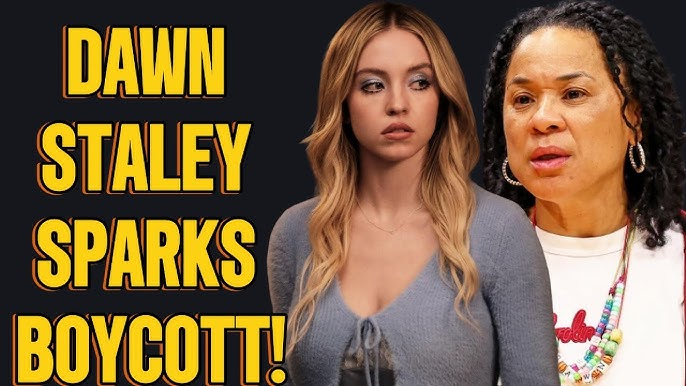
A new controversy has erupted online after a prominent sports figure publicly criticized a major clothing brand and its celebrity partner, claiming that their recent campaign disrespected Black history. A quote circulating widely on social media — “Jeans were created by us — for us. They’re woven into Black history. American Eagle and Sydney Sweeney should apologize to the Black community.” — has sparked intense debate, strong emotional reactions, and deep questions about cultural representation in fashion.
The viral post, shared alongside images of the speaker and the model featured in the campaign, has since ignited conversations far beyond fashion circles, raising urgent issues about race, identity, historical ownership, and responsibility within billion-dollar brands.
This is how one statement became a national flashpoint.
A Message That Traveled Fast

The controversy began when a respected figure in women’s athletics — pictured in the viral graphic wearing a black jacket adorned with turquoise detailing — delivered a powerful critique of a recent denim campaign released by American Eagle. The campaign, fronted by a young white model, featured modernized interpretations of classic jeans.
But for the speaker, the issue wasn’t the design — it was the message.
In the shared quote, she argued that denim has deep roots within Black history and identity, asserting that the brand failed to acknowledge or honor that cultural connection. She demanded an apology not just from the company but also from the model associated with the campaign.
Within hours, the post went viral.
It spread through sports communities, fashion circles, Black cultural pages, and general social media audiences. Thousands of comments debated the meaning of the statement: Was it a call for cultural recognition? Was it a criticism of representation? Or was it a larger frustration with how industries profit from aesthetics shaped by marginalized groups without acknowledging their origins?
Why Denim Became the Center of a Cultural Debate

To some, the idea that jeans carry historical weight may seem surprising. But historians explain that denim has been intertwined with African American labor, music, street style, and cultural expression for generations.
From:
• field laborers
• factory workers
• civil rights activists
• jazz and blues musicians
• hip-hop artists
• Black youth culture
denim has often reflected survival, creativity, and resilience.
To many in the Black community, jeans are more than fabric.
They are a symbol — of struggle, of identity, and of self-made style.
And when corporations commercialize elements of Black culture without credit or context, critics argue it becomes another form of cultural erasure.
That context explains why the quote resonated so widely, and why the demand for acknowledgement struck a nerve.
American Eagle’s Role and the Market Pressure on Brands
American Eagle, one of the largest denim retailers in the United States, has not yet issued an official response to the viral criticism. The brand has built its market on youth culture, inclusivity themes, and media-heavy partnerships.
But the backlash demonstrates a recurring problem in modern marketing:
Brands want the “look” without the history.
They want the aesthetic without the accountability.
And in the age of social media, avoiding that accountability is no longer possible.
Public pressure forced many companies in recent years to confront how they portray race, gender, and cultural narratives. American Eagle now faces similar expectations.
The Model Caught in the Controversy
The young woman featured on the right side of the viral graphic — a model with long blonde hair and a white knotted top — is not accused of wrongdoing directly. Instead, she has become symbolic of a broader issue:
Who gets to represent cultural products?
Who profits from them?
And who is erased in the process?
Critics emphasize that the controversy is not about one individual, but about the pattern — that white spokesmodels are often chosen to front trends rooted in Black communities.
Supporters of the speaker insist that the call for apology is not personal, but systemic.
Public Reaction: Divided and Intense
The viral post triggered a spectrum of reactions:
Supporters argued:
• “She’s right — the Black community deserves credit for shaping denim culture.”
• “Brands keep ignoring the roots of the trends they sell.”
• “This is about acknowledgment, not ownership.”
Opponents argued:
• “Jeans belong to everyone.”
• “The brand didn’t intend to erase anyone.”
• “The issue is being exaggerated.”
Yet the strongest reactions came from those who saw the conversation as part of a broader pattern of cultural appropriation, representation gaps, and racial imbalance in fashion.
For them, the quote tapped into years of frustration.
Experts Weigh In: Context Matters
Cultural scholars explain that debates like this emerge because fashion is not just commerce — it’s storytelling.
Fashion tells:
• who invented
• who inspired
• who influenced
• who sacrificed
• who wasn’t credited
When a powerful industry sells a product without acknowledging the communities who shaped its origins, cultural memory becomes distorted.
Experts also highlight that denim became prominent through:
• Black workers in Southern agriculture
• Black laborers in 20th-century factories
• Black musicians who popularized denim silhouettes
• Black designers who reinvented denim for modern streetwear
Thus, critics argue that ignoring this history reinforces a cycle of cultural extraction.
Why the Speaker’s Voice Carries Weight
The woman shown on the left side of the graphic is widely recognized in the world of American athletics. Though we do not identify individuals in images, she is clearly a public figure known for leadership, activism, and speaking out on issues of equity.
Her willingness to confront a major corporation gave the controversy legitimacy and urgency. Supporters see her as someone using her platform to speak truth to power.
Her critics argue she went too far, but nobody denies the impact — her words mobilized national conversation.
A Moment Bigger Than Denim
The controversy is not ultimately about jeans — it is about who gets to control cultural narratives.
It asks fundamental questions:
• Who shapes style?
• Who profits from it?
• Who gets written into history, and who gets erased?
• When a community contributes to culture, do corporations owe recognition?
For many, the answer is yes.
What Happens Now
American Eagle faces growing pressure to:
• issue a statement
• acknowledge historical context
• increase representation in campaigns
• collaborate with Black creators and designers
• ensure respectful cultural storytelling
Meanwhile, supporters of the speaker continue demanding industry-wide reform rather than a single apology.
Regardless of how the brand responds, the controversy has already achieved something meaningful:
It forced the fashion world to confront the history woven into every seam of the clothing it sells.
A Final Reflection: More Than a Viral Quote
The graphic that sparked the debate — two women, one quote, one heart symbol — captured more than frustration.
It captured a crossroads.
It asked society to look deeper, to recognize that fashion is not neutral and that cultural memory deserves respect.
Whether or not American Eagle issues the apology demanded, the conversation has already shifted. Brands are listening. Audiences are questioning. Communities are speaking.
And one statement, echoing across the internet, made sure one truth could not be ignored:
History matters — even when it’s sewn into a pair of jeans.
